Showing posts with label Wine. Show all posts

Saturday, January 3, 2015

Stoofpot van hert

Een halve fles cognac over na de kerst dus dan nog maar een keer. Ingrediënten klaarzetten.


Neem een hoeveelheid tot ruim één kilo stoofvlees van het hert. Mag dus ook 500 gram. Halfom kan ook: de helft hert en de helft everzwijn.


Snijd de groente voor in grove stukken: 2 uien, een grote winterpeen of enkele wortelen, enkele stengels selderij, een paar rapen en knoflook.


Zo'n 80 gram boter smelten tot hazelnootbruin en daarna het vlees aanbraden. Het vlees zouten en met peper bestrooien.


Voeg de groente toe aan het vlees en laat 5 minuten sudderen.


Daarna blussen met 150 ml cognac en 350 ml rode wijn.


De volgende ingrediënten toevoegen: laurierblad, tijm, 1 eetlepel mosterd, 1 eetlepel appelstroop, 1 eetlepel tomatenpuree en 250 ml wildfond. Bestrooi met 1 eetlepel bloem.


Zet de stoofpot 3 uur in de oven op 150 graden. Voeg gedroogde veenbessen toe in het laatste half uur. De stoofpot wordt beter als je hem enkele uren nagaart op een zeer lage oventemperatuur.


Wat witlof, paddestoelen en aardappelen erbij en klaar.


Wednesday, September 19, 2012

Choucroute alsacienne

Ingredients
750 grams sauerkraut
Cured pork; Dutch: zuurkoolvlees. (the traditional recipe 'choucroute garnie' has five or more different kinds of meat).
Onion
Apple
Garlic
Glass of white wine (I used a Rieflé Pinot Blanc form the Alsace. Not too dry, a little fruity, which goes nice with the pork and balances out the sour taste of the sauerkraut and apple. If possible use a Riesling)
Spices:
Juniper berries
Bay leaf
Cloves
Caraway seeds (optional: they're not used in the Alsace, but I like them)
Black pepper.


Fry the onions and garlic in goose fat (the proper way), butter or olive oil. Whatever you have. I used olive oil. Throw everything in the pot, cover and cook for 3 hours on a very slow fire. The longer the better... time is the secret to a successful choucroute d'alsace. You can cook this dish late in the evening and eat the next day. Add a little water if it gets too dry. It should be rather juicy


Serve with bread and mustard. And/or a few potatoes. I prefer bread. It's a perfect lunch as well.


Wednesday, May 23, 2012

Asparagus 2012

This year's asparagus from Spargelhof Tenbrock (An der Kapelle 3. 46419 Isselburg-Herzebocholt, Germany) were coupled with a bottle of German Weißburgunder - basically a Pinot Noir - from the wine region Nahe.


Tuesday, November 24, 2009

Glühwein

German malt wine. For 1 liter:

a 0,75 liter bottle of dry red wine
0,25 liter water
juice of one orange
juice of one lemon
12 cloves
2 cinnamon sticks
mace (optional)
sugar according to taste (I prefer 3 tablespoons)

Bring 0,25 liter water to a boil, add the spices, simmer for 10 minutes or so and let stand overnight (or at least a couple of hours). Sieve out the spices, add wine , orange juice, lemon juice and sugar. Heat to about 80 degrees Celsius. Instead of water you can start with black tea.

Weißer Glühwein:

a 0,75 liter bottle of dry white wine
0,25 liter water
fresh apple juice, according to taste (haven't tried adding apple juice myself)
juice of one orange
12 cloves
2 cinnamon sticks
mace (optional)
star anise (optional)
sugar according to taste (I prefer 3 tablespoons)

Glögg, Nordic variation:

1 bottle of red wine
0,25 liter water
10 cardamom pods (whole)
2 cinnamon sticks
dried ginger, but not ground
10 cloves
1/2 orange peel (dried or fresh)
sugar

Optional additions for serving: 1/2 cup raisins, 1/2 cup almonds.

Tuesday, October 27, 2009

Coq au vin

The recipe : Perfect coq au vin

Serves 4.

a large chicken, jointed into 6 or 8 pieces, giblets and carcass saved
an onion, a carrot and a few peppercorns for the stock
150g pancetta or unsmoked bacon in the piece
30g butter
2 medium onions
a large carrot
2 ribs of celery
2 cloves of garlic
2 tbsps flour
2 tbsps cognac
a bottle of red wine
4 or 5 small sprigs of thyme
3 bay leaves
40g butter
12 small onions, peeled
200g small mushrooms
boiled or steamed potatoes, to serve

Put the chicken carcass, its giblets and any bits and bobs of bone and flesh into a deep pan, cover with water, add an onion and a carrot, half a dozen whole peppercorns and bring to the boil. Turn the heat down and let it simmer until you need it.

Cut the pancetta into short strips; they need to be thicker than a match but not quite as thick as your little finger. Put them, together with the butter, into a thick-bottomed casserole - one of enamelled cast iron would be perfect - and let them cook over a moderate heat. Stir the pancetta from time to time - it mustn't burn - then, when it is golden, lift it out into a bowl, leaving behind the fat in the pan.

Season the chicken pieces with salt and pepper and place them in the hot fat in the casserole, so that they fit snugly yet have room to colour. Turn them when the underside is pale gold. The skin should be honey coloured rather than brown - it is this colouring of the skin, rather than what wine or herbs you might add later, that is crucial to the flavour of the dish. Lift the chicken out and into the bowl with the pancetta. By now you should have a thin film of goo starting to stick to the pan. This is where much of your flavour will come from.

While the chicken is colouring in the pan, peel and roughly chop the onions and carrot, and wash and chop the celery. With the chicken out, add the onions and carrot to the pan and cook slowly, stirring from time to time, until the onion is translucent and it has gone some way to dissolving some of the pan stickings. Add the garlic, peeled and thinly sliced, as you go. Return the chicken and pancetta to the pan, stir in the flour and let everything cook for a minute or two before pouring in the cognac, wine and tucking in the herbs. Spoon in ladles of the simmering chicken stock until the entire chicken is covered. Bring to the boil, then, just as it gets there, turn the heat down so that the sauce bubbles gently. Cover partially with a lid.

Melt the butter in a small pan, add the small peeled onions and then the mushrooms, halving or quartering them if they are too big. Let them cook until they are golden, then add them to the chicken with a seasoning of salt and pepper.

Check the chicken after 40 minutes to see how tender it is. It should be soft but not falling from its bones. It will probably take about an hour, depending on the type of chicken you are using. Lift the chicken out and into a bowl.

Turn the heat up under the sauce and let it bubble enthusiastically until it has reduced a little. As it bubbles down it will become thicker - though not thick - and will become quite glossy.

Return the chicken to the pan and serve with the potatoes.

Thursday, September 24, 2009

Nero d'Avola, red grape from Sicily

Nero d'Avola; 'black [grape] of Avola' is a red wine grape from Sicily. Makes an intense red wine suitable for red meat. I drank a 2006, Terre di Ginestra accompanied by fettuccine and a cream sauce made with: diced pancetta (fry in own fat for 5 minutes), butter (2 tablespoons), onion and garlic. Fry for 5 minutes. Add head of radicchio (a rather bitter Italian chicory). Fry for 2 minutes. Then add 150 ml. panna da cucina (lit: cooking cream) and 50 grams Parmigiano-Reggiano. Fry for 2 minutes and mix with fettuccine.

Ingredients


Dice pancetta


Fry pancetta to release fat


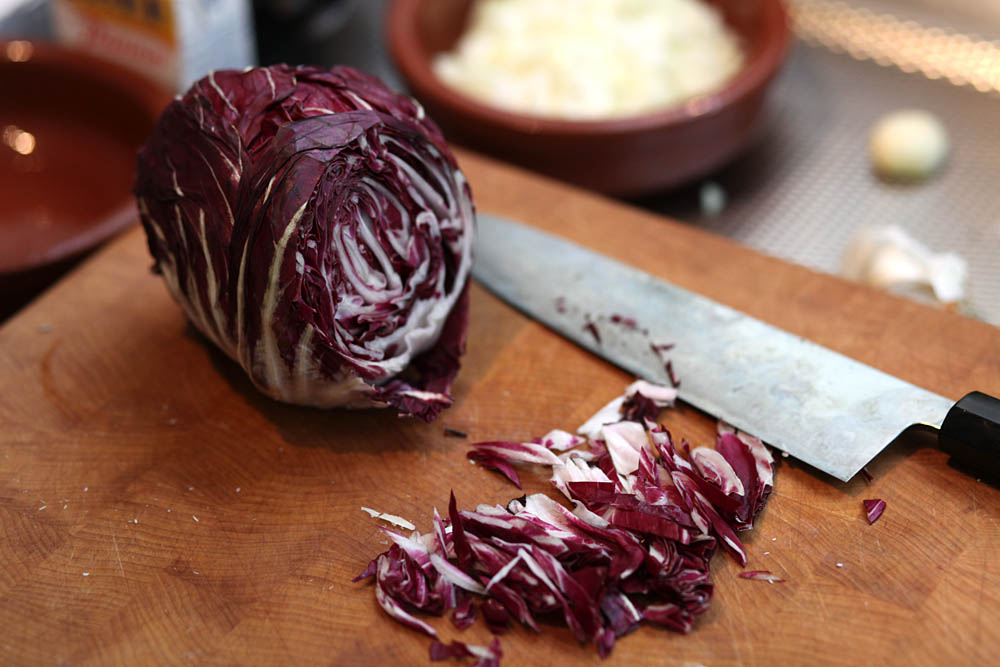
Shred the radicchio


Add butter, onion and garlic to pancetta and fry


Add radicchio and fry


Add panna da cucina and grated parmesan


Mix with pasta. The problem is that this dish doesn't look too good in color. You could add a table spoon of water to make the sauce a little less thick. The treat of this dish is the bitter taste of the radicchio offset by the rich fatty taste of cream, cheese and pancetta.

Thursday, September 10, 2009

Chateau Le Clou Monbazillac, sweet white wine

Sweet white wine Chateau Le Clou, 2005 Monbazillac, Dordogne, France. Organic wine producer, the vineyard was established in 1622.

Small 37,5 ml bottle (9,80 euro). The website hasn't been updated in a while. The last sweet wine mentioned (2001) is made of 70% Sémillon, 10% Muscadelle and 20% Sauvignon Blanc.

Drank with old Roquefort cheese and chocolate-raspberry (birthday) cake. Excellent wine, beautiful golden color. Will certainly buy again.

Wednesday, June 17, 2009

Sangria

Start with a bottle of red wine, not too expensive, not too cheap. Or use some leftover wine... Preferably a full bodied red wine.

1 lemon cut in wedges
1 orange cut in wedges

Pour wine in pitcher. Squeeze out the juice in the wine and toss the wedges in the pitcher. Add some sugar or honey according to taste.

Cool the mixture in a fridge for at least a couple of hours or overnight.

Just before serving add ice cubes and (optional) some carbonated soda.

Variation:

Add apple, peach, berries, pineapple, melon, grape, or mango to make it less of a drink and more of a fruit punch..

Sangria blanca: use Sauvignon Blanc instead of red wine.

Zurra: sangria made with peaches and nectarines. Add some lemon zest and cinnamon.

Thursday, April 30, 2009

Fresh asparagus


Originally harvested as medicine, eaten by the ancient Egyptians, fresh asparagus are one of the best things nature has to offer. Asparagus (German: Spargel) are especially popular in Germany. The harvest time is from the second Thursday of April (or March depending on the region) until June 24 (Nativity of St. John the Baptist). Buy them as fresh as possible. The thicker ones are of better quality.

Today we crossed the border into Germany to buy them directly from the farmer: 500 gram each person. On the farm (in Herzebocholt, see placemark) we also bought new potatoes and cooked ham.


View Asparagus in a larger map

Recipe:
Peel the asparagus, remove 3 centimeter from the bottom and cook 25 minutes (shorter if they're really thin) in boiling water. Serve with cooked ham, hard boiled eggs and potatoes. If they're fresh you really don't need any sauce. In Germany they're usually served with Sauce Hollandaise. Just melt some butter instead.

We drank a Pinot Blanc Cave de Beblenheim 2007 Alsace. A little too sweet but doable. In Germany they recommend Weißburgunder, Silvaner, Chardonnay or Sauvignon Blanc grape, depending on how the asparagus are served. Update: Weißer Burgunder is of course the German name for Pinot Blanc.

Thursday, April 9, 2009

Winter cheese 'vacherine' and red wine

I bought some vacherine cheese and a bottle of red wine, which should go well with the cheese.

The wine (a Beaujolais): Morgon 2006. Le Clos de Lys. Domaine J. Chamonard, propriétaire-récoltant à Villié-Morgon (Rhône).

It's an excellent wine, about 16 euro's in The Netherlands. Probably 10 euro's in France. A very light-bodied wine. Highly recommended.

Made from Gamay grape (?), which has a thin skin and few tannins.

Friday, March 13, 2009

Torre de Barreda: red wines from Spain

Torre de Barreda: Tempranillo 2006.

Torre de Barreda: Syrah 2007. Excellent with spicy sausage. 100% Syrah. Will buy again.

Torre de Barreda: Amigos 2005. Aged for 12 months in oak. Great wine but very heavy. It took me 4 days to finish the bottle.

"Het hele domein beslaat 170 ha en is net ten zuiden van Toledo gelegen. Het gebied ligt buiten de bestaande wijnappellaties, vandaar dat al de wijnen onder het label “vino de la Tierra” worden gemaakt. Het is pas met de jongste generatie, Juan Junior, dat men in 1999 de eerste “Torre de Barreda” vinifieert: een superwijn die mijlenver afstaat van de andere wijnen in de streek : boordevol fruit, zwart van kleur, een echte verleider.

Verantwoordelijk hiervoor is de jonge équipe en de hulp van een Bordelese oenoloog (Jesus Rodriguez Tapial). Zowel de basiswijn als de Selección blinken uit door hun geweldige prijs/kwaliteit-verhouding." [source]

Tuesday, September 2, 2008

Red table wines & Pinot Blanc

Domaine Deshenrys. Vin de Pays D'oc 2003. Merlot. Languedoc-roussillon. Bouchard & Fils. [used in Red Cabbage stew: one red cabbage (shredded), 200 ml. red wine, one large apple, one large onion, 100 gram butter, one tbs red wine vinegar, bay leaf, salt, pepper, nutmeg. Simmer for 3 hours. Add sugar to taste. From: La Vraie Cuisine Francaise by Robert J. Courtine. Dutch translation: De Echte Franse Keuken (Bruna & Zoon, 1963)] I don't know, the red cabbage remained quite sour and bitter despite the long cooking time. It took 3 full tablespoons of sugar to make it edible. Not really my favorite, maybe my cabbage wasn't too tasty to begin with (bought in supermarket).

Finished the remainder of the wine with blue Stilton cheese from Nottinghamshire. This Stilton is soft like butter, which means it has aged a further 5 weeks (or more?) after the usual 9 weeks it takes to make blue Stilton. Amazing cheese! Omelette with Stilton is brilliant. Beat the eggs, pour in a pan and add plenty of cubed Stilton. Fry with the lid closed.

Domaine Siméoni. Vin de Pays de l'Hérault. Mas Siméoni 2006. Organic wine. [okay but not great, won't buy again.]

White wine. Domaine Rieflé. Pinot Blanc 2007. Bonheur Convival. Vin D'Alsace. [will keep for choucroute garnie Darn, already opened it. It's a lovely wine, quite fruity and will be excellent with choucroute but also on it's own. Drink at slightly warmer temperatures: 10 degrees. Also excellent for asparagus]

Wednesday, July 23, 2008

Sauvignon 2006, Loire Valley

Sauvignon 2006, French white wine. Producer: FOURNIER Père et fils, region: Loire River banks. Grape-variety: Sauvignon. A simple white table wine. Bought for cooking mussels. It’s July and the mussels are just in season, until March next year. [a very nice wine for 8,50 euro, it was the right choice for mussels, would buy again]

More photo's on my Flickr photostream.

More wines
Pinot Blanc Bonheur Convival 2007. White wine. Grape: Pinot Blanc Producer: Domaine Rieflé. Region: Vin d’Alsace. [very fruity, I'm drinking it without food, one glass per day. However it's better to drink with a meal. Won't buy again as an evening wine, but will buy again for dinner: sauerkraut would be nice.]

Bourgogne Aligoté 2006. White wine. Producer: Catherine et Claude Maréchal. Grape: Aligoté. Contains no sulphites. [A very, very dry wine. Nice. Drank on August 30]

Royal St-Charles. Vin Mousseux sec. A French sparkling rose. Not much information on the label, but I found this wine on a Dutch website under the name: De Neuville, Royal St. Charles Rosé. [a little too sweet for my taste, drinks easily but won't buy again. The color is pretty dark red for a rose]

Tuesday, July 8, 2008

Pouilly-Fumé, Michel Langlois

Pouilly-Fumé 2007. Grape: Sauvignon blanc. Producer: Michel Langlois. Region: Pougny, Cosne-sur-Loire. What is Pouilly-Fumé?

A gift from my neighbour for watering her plants on the rooftop terrace during her holiday. Vigneron Michel Langlois should not be confused with Langlois-Chateau, a different wine producer. [not opened]

Pouilly Fumé can be kept for five to ten years, according to the year and vintage. It normally peaks in its second or third year. [source] I guess I should keep this bottle for another year or so..

Saturday, June 21, 2008

Weingut Debus Riesling Eiswein

I finally made the splurge just for myself: Eiswein from Weingut Debus, region: Rheinhessen, Germany. Grape: Riesling. Should be drunk very cold, around 4 or even 3 degrees Celsius. I drank a sparkling wine from Weingut Debus, which was really excellent. I will look out for more wine from this producer. [Update: The color is the most amazing color I have ever seen in a drink: a deep golden amber. I decided to drink the Eiswein on a hot evening on my rooftop terrace. Despite a bucket of ice, it was difficult to keep the wine cold enough: an uphill battle. The difference in taste between the first cold sip and the last warm sip was enormous. Eiswein is best drunk near a refrigerator. Also: cool the glasses beforehand. It’s a very sweet potent (taste wise) wine. Works fine with white grapes. I also bought some dark chocolate, but the sweetness of the chocolate killed the wine.]

Eiswien is made from grapes which are harvested after frost, at least -8 degrees Celsius, in December or even January. Eiswein has an increased concentration of sugar as a result of freezing out water.

Prabi Bianco 2006

Prabi Bianco 2006, Italian white wine. Producer: Cesconi, region: Trentino Alto Adige, Dolomites, Northern Italy. Grapes used: Manzoni Bianco, Riesling (5%), Pinot Bianco (15%). Good with fish. [Excellent wine, highly recommended. Also excellent without food]

Note:
Manzoni is a grape made by crossing Pinot Bianco and Riesling Renano (=alternative name used in Italy for the German Riesling grape).

Thursday, May 15, 2008

Wine

I should start writing down the wines I've bought for future reference. Most wines are between 10 and 15 euro per bottle, all bought at Van Bakel & Cavé located in the Kerkstraat, Amsterdam. Photo: Jean-Pierre Margan, owner of Château la Canorgue.

Château la Canorgue 2004. Red wine. Organic farming, producer: Château la Canorgue, region: Southern Rhone, Appellation d’Origine Contrôlée (AOC) Cotes du Luberon. [I don't really have an opinion on this wine, to be fair, I had a bit of a sore throat when I drank this bottle, undecided]

Canorgue 2005, White wine. Organic farming, producer: Château la Canorgue, region: Southern Rhone. Nice with bass, so I was told. [good wine, will buy again]

Vin de table de France, Louis et Chantal Julian Vignerons, Ribaute. Red wine, one liter bottle. Organic farming, does not contain sulfite. [one of the better simple table wines I have drunk, though not very complex. It has a little added carbonic acid. Open in advance for the gas to dissipate; good for cooking]

Weingut Debus, 2005 Sprendlinger Klostergarten, Pinot Noir. Rosé Brut. German sparkling wine from quality grapes. Region: Rheinhessen. [Very nice! A winner. Will buy again. Drunk without food]

I have six Schott Zwiesel wine glasses: 2 for red wine, 2 for white wine and 2 for sparkling wine. The red wine glasses are the Diva 'Burgunderpokal Claret Burgundy'. It's a huge glass, holding up to 839 ml! I wish I could remember the series of the other glasses. Diva as well, Fortissimo?

Thursday, April 17, 2008

Octopus in red wine

This recipe is Greek: Oktapodi Krasato. You need a kilo of baby octopus to serve two people if used as a main course or four to eight people if used as antipasto. This recipe tastes even better the next day. Beware: it takes almost 3 hours to prepare.

Unfortunately, unless you're living near certain coastal areas, it's very difficult to obtain fresh baby octopus. You're more likely to find them cleaned and frozen. The one's I bought were packaged in Vietnam. Defrost the octopus and cut in smaller pieces; slice the head in two and cut the tentacles in sets of four. Boil the octopus in their own liquid for 20 minutes. You'll be surprised how much water will be released. Boil until dry. If that takes too long discard excess water.

Add a a few tablespoons of olive oil and 200 gram of whole pearl onions (of course, remove the outer layers). They are really tiny onions used for pickling; zilveruitjes in Dutch. Coat the octopus and pearl onions with olive oil and fry for a minute or so. Then add:

200 ml of red wine
80 ml of red wine vinegar
one cup of water
one tomato, skinned and grated or made into a pulp
one bay leaf
one teaspoon of dried oregano
half a teaspoon of crushed black pepper

Simmer for 1,5 to 2 hours until the octopus is tender. You should be left with a thick, not watery, sauce covering the octopus and onions. Do not use cheap wine for this recipe.

I buy my wines at Van Bakel & Cavé located in the Kerkstraat, Amsterdam. The owner of this small shop is a professional enologist. All the wines he sells have been properly tested on their chemical make-up, including the level of sulfite and the type of yeast. In his career he has reported about 500 instances of bad and even dangerous wines to the Dutch ministry of health. However, on average it takes at least three months for the authorities to spring into action, if they take any action at all. In the meantime these wines are being sold to the unsuspecting public. This should be considered a scandal.

Last summer he tested a batch of Argentine wine and found a type of yeast which - at temperatures above 15 degrees Celsius - produces dangerous levels of oxygen. He declared the batch unsafe for consumption and the boxes were labelled as such. Regardless of this, the batch was sold to bars and restaurants for less than 2 euros per bottle. This resulted in numerous exploding bottles of wine, causing at least one nearly fatal injury. This story never made the newspaper.