Showing posts with label Pasta. Show all posts

Tuesday, September 11, 2012

Spaghetti Aglio e Olio

Boil spaghetti.

Heat a quality olive oil on a low fire. Add crushed garlic and dried red chilli. Simmer until the garlic turns light brown. Remove chilli and pour the oil over the drained pasta.

Season with parsley. No cheese, no black pepper.


Monday, September 3, 2012

Zuppa 'e suffritto from Napoli

I wish I had the exact recipe for this. My Italian neighbour invited me for dinner. He made a 'soffritto' and pasta. I quizzed him for the exact recipe but it was impossible to learn how the soffritto was made. His Dutch is quite poor. An Italian soffritto is not to be confused with the Spanish 'sofrito'.

For a start, there were no onions involved. What I could understand was that the soffritto was made from tomatoes, but not just any kind of tomatoes. You can't make this soffritto from an ordinary can of tomatoes or even ordinary fresh tomatoes. It was unclear what kind of tomatoes he was referring to exactly. Strangely, the soffritto recipes I can find online contain no tomatoes but a mixture of celery, carrot and onion. These soffritto's are Tuscan recipes. My neighbour hails from Napoli. I guess in Napoli a soffritto is somewhat different from Tuscany. Basically you fry tomatoes in olive oil and spice the mixture with bay leaf and (a few) dried chilli peppers. His 'soffritto' contained no onions. And by the look of it also no celery or carrot.

Once the soffritto is ready you add and simmer bite sized pieces of pig's lung, liver and heart until completely soft. You'll end up with a very powerful and incredibly tasty sauce for pasta, spaghetti in this case. I asked him where he bought pig's lung, liver and heart in Amsterdam. He didn't. A friend brought the organ meat straight from Italy. In contrast with The Netherlands, in Italy the consumption of entrails and internal organs is widespread. It also seemed that the soffritto was also brought from Italy, but that bit got lost in translation as well.

So, do I have enough information to recreate this dish? I'm not sure. The secret ingredient seems to be right kind of tomatoes. And it seems it will be impossible to find those tomatoes in The Netherlands, but I have to say that my neighbour is passionate about his tomatoes. Even canned he prefers them straight from Italy because they will be more 'fresh'. In October his Italian friend will bring some more soffritto from Italy. I'm invited for another meal.

And I have to say.. this pasta, soffritto and pig's lung, liver and heart was just very very tasty! It's a shame Italian restaurants in The Netherlands will never serve this pasta sauce. Why? In The Netherlands the aversion against entrails and internal organs is widespread.

Update: I discovered there is a 'soffritto' from Napoli: "Zuppa 'e suffritto". From Wikipedia: "Il soffritto 'u suffrittu è tutt'altra cosa. Trattasi di uno stracotto di interiora di vitello, di capretto o di agnello, più raramente di maiale, cucinato con conserva di pomodoro, cipolla, sedano, olio d'oliva ed abbondante peperoncino rosso. Simile al murseddu catanzarese. A Napoli la stessa ricetta nella variante di maiale è ben conosciuta e apprezzata nella cucina popolare con il nome di "Zuppa 'e suffritto". Utilizzata da sola, sul pane o sulla pasta. Viene venduta anche già pronta in macelleria."

A recipe for Zuppa 'e suffritto

(Cut & pasted from the internets)

Ingredients:
Obtain at least 1.5 kg of pork offal: lung, spleen, heart, trachea (=lung pipe), red wine, oil, grease, tomato paste, bay leaves, chili, rosemary, salt.

Chop the innards after being thoroughly washed. Then fry with olive oil and lard and agiungete (=add) red wine, a couple of bay leaves, rosemary, salt and much pepper. Cook slowly for a couple of hours, adding a bit 'of water*. Serve with croutons or noodles.

*) the tomato paste seems to be missing. I guess you add the tomato paste after frying the innards.


And a better photo of the left over sauce the next day:


Wednesday, August 10, 2011

Spicy tomato sauce (for cold poached fish)

From Rick Stein's Mediterranean Escape, episode 2 (Sardinia).

Fry one onion and a few cloves of garlic in olive oil in a sauté pan. Add a few bay leafs, crumble some dried chilies and add a handful of parsley. Add a can of plumb tomatoes, plenty of salt and raisins (for an Arabian flavor). Season with red wine vinegar.

Cut the onion very finely.

In the program this sauce was served cold with poached fish (skate wings, skin peeled off after poaching in salted water).


But it's also a perfect sauce for hot pasta.


Tuesday, July 19, 2011

Pipe Rigate ai Piselli e Prosciutto

This recipe is both incredibly simple, tasty and rather laborious.

For the pasta I used rigatoni instead of pipe rigate.

Instead of piselli (peas) I used broad beans (Italian: fava, Dutch: tuinbonen). We spent the first half hour skinning the broad beans, first the pods, then the skin from each bean.


Next step: melt 1 tablespoon of butter with 1 tablespoon of olive oil and 2 cloves crushed garlic and add the beans or peas.


Add 150 ml chicken stock, wine or water. I used chicken stock. It's salty so be careful not to add too much salt. Sprinkle chopped parsley, season with salt and pepper and simmer for 5 -8 minutes. In the meantime boil the pasta.


Shred 100 gram of prosciutto crudo (dry-cured ham). I used Parma ham. It's expensive (5 euro per 100 gram) but worth it.


Add 100 ml panna da cucina and boil on high heat until the sauce thickens while stirring.


Add the Parma ham and remove from fire.


When the pasta is cooked add 1 tablespoon of butter and 100 ml panna da cucina to the hot pan.


Add the drained pasta.


Finally, pour in the sauce and toss. Sprinkle with fresh herbs before serving.

Monday, November 1, 2010

Farfalle alla Crema di Gorgonzola


Just three ingredients: panna da cucina, gorgonzola and fresh sage. Well, and black pepper and farfalle pasta...

Melt 175 gram diced gorgonzola in 200 ml. panna da cucina (for 300 - 400 gram pasta). Add plenty of black pepper. Remove pan from heat.

In the meantime cook pasta. Drain and pour gorgonzola sauce into the pan with the pasta. Add finely chopped sage. Season with salt and serve immediately.

Tuesday, September 21, 2010

Ragù alla Bolognese II

I already made some notes on this Italian meat sauce.

My version for the 2010 Berlin Marathon carbo-loading week.

This recipe is based on the "official" recipe from the Accademia Italiana della Cucina as announced on October 17, 1982. Serve with Fettuccine or Tagliatelle and Parmesan cheese.


For 8 people:
600 gram minced beef
200 gram coppa (this should have been pancetta but three butchers in a row where out of pancetta) (very finely cut)
2 chicken livers (* not part of the official recipe) (finely cut) The Accademia allows the addition of Porcini mushrooms.
100 gram onion (finely cut)
100 gram carrot (finely cut) My Italian neighbor says I have to grate the carrot and not cut it.
100 gram celery stick (finely cut)
200 ml passata di tomato (* official recipes says 60 gram concentrated tomato puree)
A glass of white wine
Beef stock (* not part of the official recipe)
350 ml milk
Olive oil
Salt and pepper

Fry coppa in its own fat. Add chicken liver. Add some olive oil and fry the onion, carrot and celery. Fry until vegetables are transparent.


Add minced beef. Fry until brown.


Time to add the white wine and some beef stock. Beef stock is not part of the original recipe so I added only a few soup spoons. Next add the passata di tomato.

Then add the milk little by little until it is completely absorbed.

Season with salt and pepper, cover and cook very slowly for 3 to 4 hours.

Friday, June 18, 2010

Ragù alla Bolognese I

Updated!

There is one 'official' way to make Ragù alla Bolognese, registered in 1982 by the Bolognese delegation of Accademia Italiana della Cucina. The ingredients are: beef, pancetta, onions, carrots, celery, tomato paste, meat broth, red wine, and milk or cream.

My version in 2009:

Fry 200 gram pancetta in its own fat. Add one onion, stick of celery and big carrot (al diced in very, very small cubes) and fry for 5 more minutes.

In the meantime fry 400 gram ground beef in very little oil.

Add the beef to the pot, add 500 ml beef broth, 250 ml passata di pomodoro and 250 ml white wine*. For an extra punch I added a small can of tomato paste.

Simmer on a very low fire for 3 hours.

Some thoughts for 2010
Add two chicken livers, finely chopped.

Stir in 125 ml. cream or marscapone in the last 5 minutes.


More thoughts:
1) Heat 125 ml. olive oil, then add the diced vegetables and stir over high heat for 5 minutes. Add the pancetta, then add the chicken livers and brown. Mash the chicken livers with a fork as they cook to help them blend into the sauce.

2) Season 750 gram ground chuck steak with salt and pepper, and add. Make sure the meat is at room temperature to allow it to sear and not stew when it hits the pan. Brown the meat, stirring occasionally to prevent the vegetables from sticking. Add pinch of nutmeg.

3) Add the white wine and let it bubble up until it has almost evaporated.

4) Add the heated stock a cup at a time, allowing each cup to evaporate and enrich the sauce before adding the next. This is much like the process of making a risotto and will give you a truly voluptuous sauce.

5) Pour in the tomatoes with their juice, bring the whole pot to a boil then reduce to a low simmer and allow to gently bubble, uncovered, for 3 hours, stirring occasionally.

6) Stir in 125 ml. cream or marscapone in the last 5 minute.

Monday, February 8, 2010

Spaghetti with Tuna, Mushrooms and Pancetta

Tried & tested:

Soak 15 gram dried porcini in hot water for 20 minutes.

Heat oil, add one clove of garlic, crush gently and cook for 2 minutes. Discard garlic.

Add 75 gram diced pancetta or bacon and fry for 4 minutes.

Add drained dried porcini (chopped finely) and 225 gran chopped button mushrooms. Fry for 2 minutes and add soaking liquid from the mushrooms (about 6 table spoons). Simmer for 10 minutes.

Cook pasta, adding remaining soaking liquid from the mushrooms.

Add a can of tuna to the sauce and taste for pepper and salt.

Toss pasta with the sauce and serve with grated Parmesan.

Note: leave out pancetta (or even the tuna) for a vegetarian version. Update: tried it and it doesn't taste as good. You need some pancetta, if only a little.

Monday, February 1, 2010

Spaghetti with Saffron

For this simple dish you will need dried spaghetti, a few strands of saffron, 150 gram cooked quality ham, 200 ml panna da cucina, 2 egg yolks and 50 grams freshly grated Parmesan cheese.

Cook the pasta.

In the meantime put the saffron in a few tablespoons of water and bring to a boil. As soon as it boils turn off the heat and leave to stand for a while. Add strips of ham. Stir in the panna da cucina and Parmesan. Add salt and pepper and heat gently while stirring. Remove from heat and add egg yolks. Mix well.

Add the sauce to the drained pasta and toss.

Serve with extra grated Parmesan.

Monday, November 23, 2009

Penne ai Gamberetti con Pernod

« Le pastis, c'est comme les seins : un, c'est pas assez, et trois, c'est trop. »

Penne with prawns and Pernod.

200 ml panna da cucina
250 ml fish stock
250 gram penne (for 2 persons)
50 ml Pernod
250 gram peeled & cooked prawns
2 tablespoons chopped fresh dill, plus more to garnish
salt and pepper

1. Heat cream and fish stock on a low fire. Simmer for 15 minutes until reduced by half. Add Pernod and prawns, season with a generous amount of salt and pepper.


2. In the meantime cook the penne.

3. Drain penne into bowl, add cream mixture and fresh chopped dill. Toss and garnish with some more chopped dill.


Monday, September 28, 2009

Linguine with lemon

A simple tangy lemon-cream sauce.

Juice of two lemons
50 gram butter
200 ml panna da cucina
100 gram Parmesan, grated
salt & pepper

1) Boil and simmer for 5 minutes: lemon juice, butter and cream. Add salt and pepper. You can add some grated lemon rind as well.

2) Meanwhile cook linguine (or similar pasta).

3) Add Parmesan to cream sauce. Taste. Mix with drained linguine. Above quantities are good for 2 - 4 people. Serve as an 'in-between' dish.

Just 4 ingredients:

Thursday, September 24, 2009

Nero d'Avola, red grape from Sicily

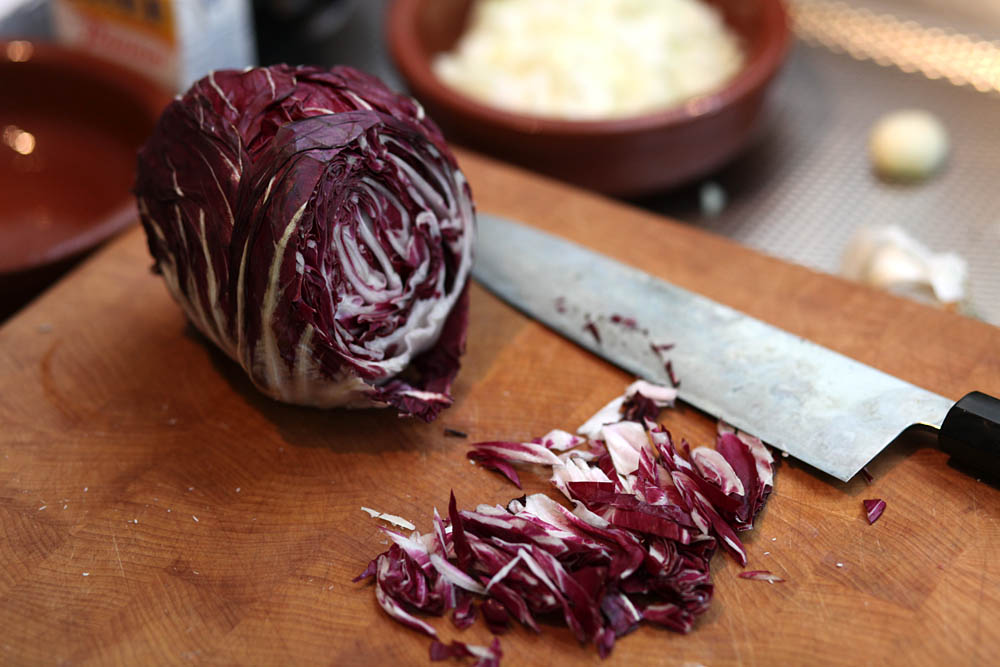
Nero d'Avola; 'black [grape] of Avola' is a red wine grape from Sicily. Makes an intense red wine suitable for red meat. I drank a 2006, Terre di Ginestra accompanied by fettuccine and a cream sauce made with: diced pancetta (fry in own fat for 5 minutes), butter (2 tablespoons), onion and garlic. Fry for 5 minutes. Add head of radicchio (a rather bitter Italian chicory). Fry for 2 minutes. Then add 150 ml. panna da cucina (lit: cooking cream) and 50 grams Parmigiano-Reggiano. Fry for 2 minutes and mix with fettuccine.

Ingredients


Dice pancetta


Fry pancetta to release fat


Shred the radicchio


Add butter, onion and garlic to pancetta and fry


Add radicchio and fry


Add panna da cucina and grated parmesan


Mix with pasta. The problem is that this dish doesn't look too good in color. You could add a table spoon of water to make the sauce a little less thick. The treat of this dish is the bitter taste of the radicchio offset by the rich fatty taste of cream, cheese and pancetta.

Tuesday, June 24, 2008

Spaghetti Carbonara

Many people know this Italian dish as a creamy spaghetti sauce. However, Spaghetti Carbonara doesn’t contain any cream.

Just 7 ingredients:

Spaghetti (400 gram)
Pancetta (better: guanciale)
Egg (2 for 400 gram)
Pecorino romano, grated (40 gram)
Parmesan, grated (40 gram)
Garlic (crushed)
Black pepper and salt

The egg is the sauce. Fry diced pancetta in olive oil, add crushed garlic. Boil spaghetti. Put spaghetti in a hot bowl, add hot pancetta and oil but remove the garlic. Add half the cheese.

Break one egg, or egg yolk, per person over the spaghetti, add the rest of the cheese and mix. The heat of the spaghetti will cook the egg. The egg and cheese will form a cream like sauce. Garnish with parsley.

Even more authentic: use half Parmigiano-Reggiano, half Pecorino Romano. The prefered meat is not pancetta but guanciale, if you can find it outside of Italy.

Thursday, June 19, 2008

Moretum, the origin of pesto


“A single colour, not entirely green

Because the milky fragments this forbid,

Nor showing white as from the milk because

That colour's altered by so many herbs.”

- Moretum

Moretum is the proto pesto. Vergilius (70 BCE – 19 BCE) mentions a moretum recipe in the poem of the same name. His moretum does not contain any basil, but a mixture of parsley, cress, endive and colewort. However, all the other elements (salt, garlic, olive oil and hard cheese) are there, more than twenty centuries ago.

The proper ingredients for a modern pesto Genovese:

A bush of fresh basil leaves, at least 50 gram just the leaves.
2 to 4 tbsp Parmigiano Reggiano (minimal 24 months old)
2 to 4 tbsp Pecorino Sarde (Pecorino Romano is too salty)
2 tbsp pine nuts
1 tsp salt
2 gloves of garlic
200 ml. olive oil, Ligurian preferably.

First crush the salt, pine nuts and garlic in a mortar. You need a big mortar, an electric kitchen machine will do, but after reading Vergilius’ poem, how can you not use a proper mortar and pestle? I bought a heavy granite stone mortar and pestle from Thailand for 25 euro.

Seperate the basil leaves from the stems. Cut the basil leaves with a sharp knife, so you don’t end up with whole leaves in the mortar, do not crush the leaves at this point!

In the mortar rub the basil leaves together with the salt, nuts and garlic, add the very finely grated cheeses in a 1:1 ratio (or more Parmigiano Reggiano than Pecorino Sarde). Carefully mix in the olive oil while rubbing the mixture with the pestle. Do not mash.

Never cook pesto. When heated basil gets bitter.